ADVERTORIAL — Sponsored Content / Educational Information
Danger Zone Warning

If Your Feet Burn, Tingle Or Go Numb At Night… You May Already Be Entering The Danger Zone For Amputation.

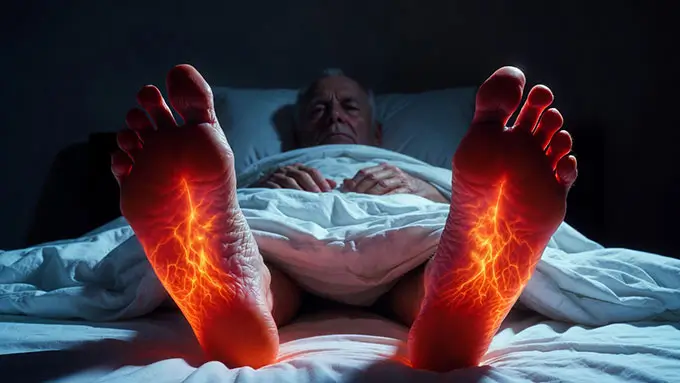
Ignore the burning, tingling or numbness tonight… and the damage inside your nerves may steal your ability to walk tomorrow. See the disturbing evidence of how hidden nerve erosion destroys mobility and independence.

Burning Tingling Numbness

Neurologists say there may be a specific biochemical reason neuropathy pain intensifies after dark.

SEE WHAT MAY BE BEHIND YOUR NIGHT PAIN

No commitment  ·  No credit card  ·  Just the explanation

Men and women living with painful diabetic neuropathy are doing everything right — controlling blood sugar, taking medications, following their doctor’s advice.

And still waking up at 2 or 3 AM with burning, stabbing pain that won’t stop.

The burning starts when the house goes quiet.

You already know what diabetic neuropathy is. You've lived with it.

The electric shocks...
The numbness...
The feeling of walking on gravel even when standing still.

Neurologists see this pattern all the time. Neuropathy pain often gets worse at night.

But very few explain why.

Emerging Research — Nerve Biochemistry

Researchers now believe something else may be happening inside the nerve itself.

In diabetic neuropathy, chronically elevated glucose may trigger the overactivation of an enzyme called MMP-13
That enzyme can slowly break down the protective insulation around nerve fibers — disrupting the signals your nerves send to your brain
At night, when movement and activity stop, there is nothing left to mask the distortion
And when the body becomes quiet… the distorted signals become impossible to ignore.

Quick Self-Check Neurologists Use to Detect Early Neuropathy

If you answer yes to three or more of the following questions, your nerves may still be in a stage where they can respond to targeted support:

Neurologists say this pattern often appears before serious nerve damage becomes permanent.

Check Every Symptom That Applies to You
Tap each item that matches your experience
Do you feel burning or electric shocks in your feet or legs, especially at night?
Do your feet feel like they are on fire, even when they feel cold to the touch?
Have you noticed that your neuropathy pain gets worse after sunset, making it hard to sleep?
Do you have random stabbing pain — even when sitting still — that hits without warning?
Have you tried gabapentin, Lyrica, or similar medications and found only partial relief or unacceptable side effects?
Are you worried about your long-term mobility, your independence, or the risk of serious complications including amputation?
Do you feel like you are getting older faster than you should — that your body is failing you after everything you have put into it?


The Neurologist Who Noticed Something No One Else Was Seeing

Dr. Lewis Clark has spent 27 years working specifically with patients who have painful diabetic neuropathy.
For most of that time, he believed what most neurologists still believe today.

Dr. Lewis Clark, Neurologist
Dr. Lewis Clark, MD
Board-Certified Neurologist · 27 Years Specializing in Painful Diabetic Neuropathy

"For most of my career, I told patients what every neurologist says — 'We can manage the pain, but we cannot reverse the damage.'"

"I believed that for years.

And I was wrong."

"At least for a subset of patients who still have recoverable nerve function left."

"The research around MMP-13 enzyme activity in peripheral neuropathy changed how I approach treatment.

The real question is not just how to block the pain signal — but why the nerve is sending that signal in the first place."

"For patients in the early-to-mid stages of neuropathy, the nerve may not be permanently damaged yet. In many cases, it may simply be struggling to protect itself."

"But the window to act is not permanent. That is what most patients do not realize until it is too late."

57%
of all people with diabetes develop peripheral neuropathy — and it is the leading cause of non-traumatic lower limb amputation in the United States.
Source: American Diabetes Association

But here is what most people are never told: Painful diabetic neuropathy does not always progress because your blood sugar is out of control. In many cases, it progresses because of something happening at the cellular level inside the nerve itself — something that standard diabetes management does not address.


The Hidden Nerve Mechanism Most Doctors Never Explain

Inside every nerve fiber is a protective coating called the myelin sheath. Think of it like the insulation around an electrical wire. When that insulation is healthy, signals travel smoothly.

But when that insulation begins to break down, the signals become distorted.
And that’s when the burning begins.
In people with diabetic neuropathy, researchers now believe that elevated glucose over time may trigger the overactivation of an enzyme called MMP-13.

The burning.

The stabbing.

The electric shocks.

The feeling that your feet are on fire when the house goes quiet at night.

This may explain why simply increasing gabapentin often fails to solve the real problem.
Gabapentin suppresses the signal.
But it does not address what may be creating the signal in the first place.

In many cases, the nerve is not dead. It may simply be inflamed, compressed, and deprived of the nutrients it needs to protect itself. That distinction matters. Because it changes what you do next.


Real People. Real Frustration. Real Fear.

These are real people who tried the usual path. Most of them had not yet seen the explanation you are about to watch.

"I have had diabetic neuropathy for 6 years. Some days I can barely walk to the mailbox. The burning pain wakes me up every single night at 2 or 3 AM. I am so tired of doctors just saying 'it's something you have to live with' and throwing more gabapentin at me. I just want one good night of sleep."
Jason D., Texas
Person sitting on bed at night holding foot in pain
Night pain is not just a perception issue — there is a biochemical explanation for why it intensifies after dark.

"Anyone else deal with the stabbing pain that shoots up from your feet at random times? I'll be sitting watching TV and BAM — feels like someone stuck a knife in my foot. Happens 10 to 15 times a day. Gabapentin helps a little but makes me so foggy I cannot think straight. I am 67 and feel like I am 90."

Francis P., Arizona

"I've tried gabapentin, Lyrica, creams, vitamins. Nothing works. My biggest fear is ending up like my uncle who lost both legs."

Morty P., North Carolina

▶ Watch Free — Less Than 15 Minutes

You Have Managed This Alone for Long Enough.

You’ve taken the medications. You’ve followed the advice.
And still the burning wakes you up at night.

What you may not have seen yet is a clear explanation of why neuropathy pain often gets worse after dark.

The short video above explains what researchers now believe may be happening inside the nerves — and why many treatments never reach the real cause.

It takes less than fifteen minutes to watch.

After everything you have been through, you deserve at least that.

SEE WHAT MAY BE CAUSING YOUR NIGHT PAIN →

No commitment  ·  No credit card  ·  Just the explanation

Frequently Asked Questions

Neuropathy pain often intensifies at night because the body becomes quieter. Circulation slows slightly, movement stops, and the nervous system loses the normal signals that help "mask" damaged nerve activity during the day. When this happens, irritated nerve fibers can become the dominant signal your brain receives — which is why the burning, stabbing, or electric sensations often feel strongest after dark. Researchers now believe this nighttime pattern may be linked to biochemical stress inside the nerve itself.
Your doctor is not wrong in many cases. When nerve fibers are severely damaged, that loss can be permanent. But researchers have found that in earlier stages, the nerve may not be completely destroyed yet. Instead, it may be struggling inside an unhealthy biochemical environment that interferes with its ability to protect itself. That distinction matters. Because if the nerve is still active, supporting that environment may help reduce stress on the nerve and improve function.
There are several indicators neurologists often look for. People who still experience burning, stabbing, or fluctuating pain — especially symptoms that change with temperature, position, or time of day — may still have active nerve function. The short video on this page explains the signs doctors use to determine whether nerves may still be responsive to targeted support.
Medications like gabapentin are designed to suppress pain signals traveling through the nervous system. For some patients this can provide partial relief. However, these medications do not address the underlying stress affecting the nerve tissue itself. They quiet the signal — but they do not necessarily resolve what may be creating that signal inside the nerve. That is why many patients find the pain returns when medication effects wear off.
This is a very common experience. Standard vitamin supplements often struggle to reach damaged nerve tissue effectively, especially when the biochemical environment around the nerve is already under stress. The approach explained in the video focuses not only on the nutrients themselves, but also on the forms and combinations used to help those compounds reach and support the nerve environment more effectively.
The formulation discussed in the video contains natural compounds commonly used in nutritional support — including Alpha Lipoic Acid, B vitamins, Coenzyme Q10, Magnesium, and Butcher's Broom. It is not intended to replace diabetes medications or alter your treatment plan. As with any supplement, it is always appropriate to mention it to your physician, particularly if you are managing diabetes or taking prescription medications.
The formulation combines several compounds commonly studied for their relationship to nerve health and circulation. These include antioxidants that help reduce oxidative stress, nutrients that support myelin sheath integrity, and compounds that assist cellular energy production inside nerve tissue. The goal is to support the biochemical environment surrounding the nerve — rather than simply masking pain signals.
Yes. Painful peripheral neuropathy occurs in people with both Type 1 and Type 2 diabetes. The biochemical stress affecting nerve tissue is related to long-term metabolic and inflammatory processes that can occur in either condition. Because of this, the nerve-support strategy discussed in the video may be relevant to individuals living with either form of diabetes.

Free Guide: Understanding Diabetic Neuropathy Night Pain

Download our free PDF guide and learn what may be driving your symptoms — and what the latest research suggests about addressing the root cause.

⬇ DOWNLOAD FREE PDF GUIDE Instant access · No sign-up required
▶ WATCH THE FREE EXPLANATIONSee what may be behind your night pain